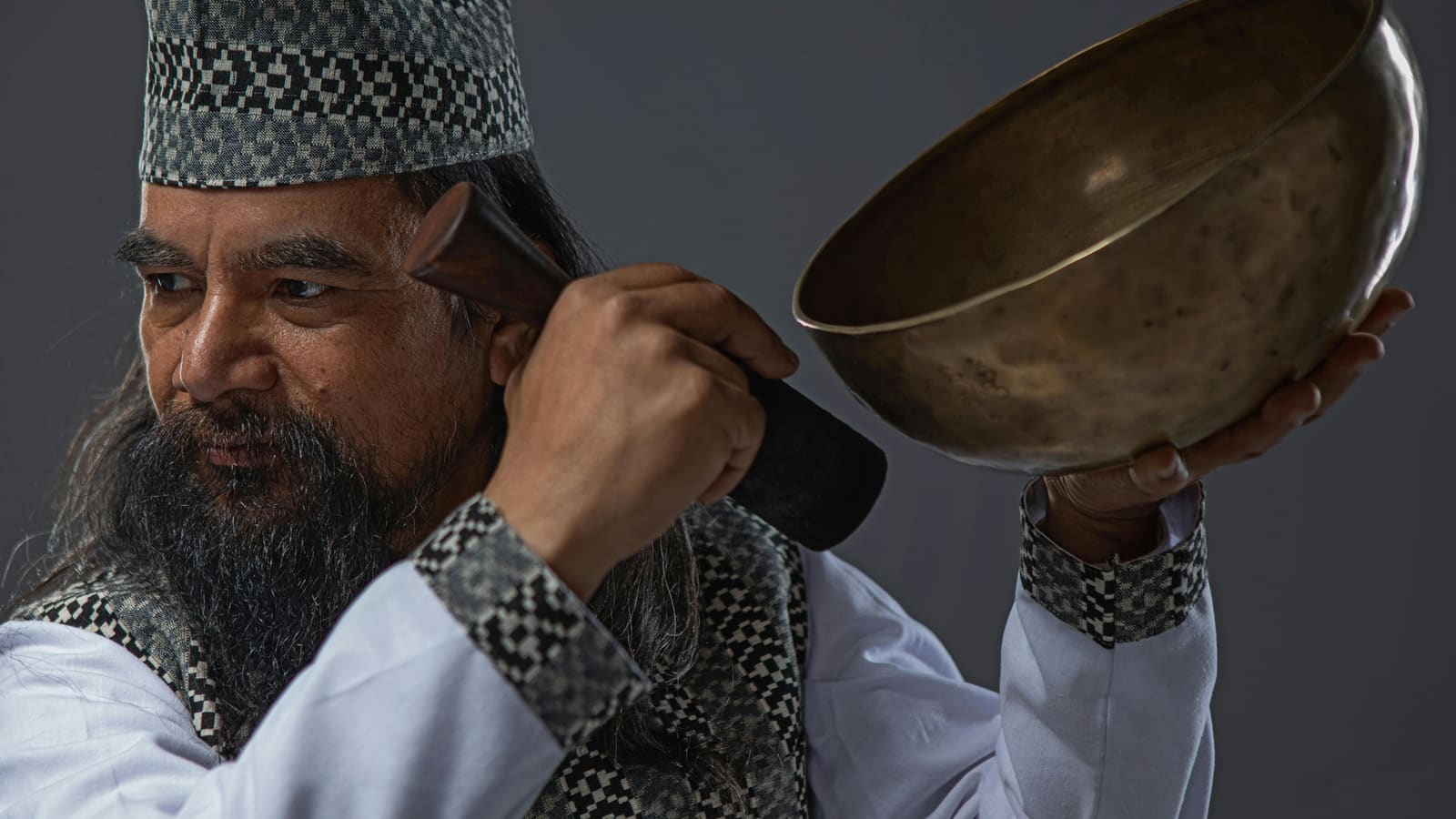
What the instruments do
What a sound bath actually is — and what 'just music with bowls' misses
If you have only ever read about sound baths online, the chances are good that the most important parts have been left out. Here is the form, calmly described, and the reasons it produces what it produces.
A friend who teaches engineering described her first sound bath this way: “It was lying on the floor in a basement with twelve strangers while a woman hit bowls.” She meant it as a compliment. She had come in expecting music plus relaxation and discovered it was its own thing — closer to a guided dental procedure than to a Spotify playlist. Quieter. Slower. Run by someone whose entire job, for the hour, was the room.
That is most of what a sound bath actually is. The instruments matter. The format matters more.
The form, plainly
A sound bath is a group session, usually 45 to 90 minutes, in which everyone present lies down in a dim room while a facilitator plays acoustic instruments — most often singing bowls, sometimes gongs, sometimes voice, often a mix. There is no choreography. You are not asked to do yoga. You are not asked to share. Phones go to the side of the room. Eyes can be closed, or open and looking at the ceiling. The facilitator chooses when to begin and end.
The “bath” metaphor is literal in the acoustic sense. You are receiving sound from many directions, at low and middle frequencies you can feel in your chest as much as hear, and the room itself begins to feel viscous with it. The facilitator moves around the perimeter, occasionally near a body, occasionally far. Nothing is performed at you in the way music is performed at an audience.
Two things distinguish this from any of the obvious alternatives.
It is not music in the listening sense. Music asks you to follow it — a melody, a beat, a story. Sound-bath bowls and gongs do not move that way; their tones sustain and slowly overlap. The mind, finding nothing to track, eventually stops tracking. That stopping is the point.
It is not meditation in the seated sense. You are lying down, which removes most of the postural work. You are surrounded by sound, which means your attention has somewhere natural to rest. The facilitator is keeping time, which means you don’t have to. A sound bath is the meditation equivalent of being driven somewhere instead of having to drive.
Why the format does what it does
The peer-reviewed literature on sound baths is small but consistent. An observational study of 62 adults by Tamara Goldsby and colleagues at UC San Diego (2017) found measurable reductions in tension, anger and depressed mood after a single session, with larger effects for people new to the practice. A feasibility study in metastatic cancer patients (Bidin et al., 2016) found Tibetan-bowl sessions were well-tolerated and lowered self-reported anxiety. A 2020 systematic review by Stanhope and Weinstein noted that the existing evidence base is small and methodologically uneven, but consistent in direction: people leave sound baths feeling better.
The likely active ingredients, as best the literature can identify them, are not exotic:
- Lying still in a dim, safe room for an hour. This alone lowers cortisol in most people.
- Slow, sustained, low-frequency sound. Your breath naturally lengthens to match a room of long tones. Slow exhales increase vagal tone, which calms the body.
- The held container. Someone else is running the time. Your prefrontal cortex, which has been making decisions all day, gets to go off duty.
- Low-frequency vibration coupling with the chest cavity. Below about 250 Hz, sound becomes something you feel as well as hear. Bone-conducted vibration is part of what makes the experience different from headphones.
None of this is the bowls “tuning your cells”. The bowls are an excellent delivery system for low-frequency sound and a clear social-safety cue. The thing they do to the body is mostly the same thing a long slow breath does — they make it easier to do.
What it is not
It is worth being clear about what a sound bath does not do, so the disappointment afterwards isn’t on the practice for not being something it never claimed to be.
- It is not a medical treatment. It can help with stress, sleep, and the kind of held-in tension that responds to safety. It does not cure cancer, repair DNA, balance chakras in any measurable way, or substitute for psychotherapy or medication.
- It is not initiation. Modern sound baths in Mexico are open-door practices. You are not joining anything. You can attend one and never go back.
- It is not “sound therapy” in the clinical sense. Sound therapy — used by audiologists, music therapists, and somatic clinicians — is a distinct, regulated field. A group sound bath is recreation and self-care, not treatment.
Where to begin in Mexico
A first sound bath is best done in a city where there are several to choose from, so you can find one whose voice feels right. The studios on Mexico City’s sound-bath scene — Encalma, Sundari, Camino del Sonido, the Roma Norte studios — host weekly or bi-weekly group sessions in the MXN 350–700 range. Tulum and Mazunte have a slightly more retreat-flavoured version, often combined with cacao or gentle yoga.
Whatever city you’re in: read the practitioner’s profile first. The five questions worth asking are training, modalities, languages, contraindications, and what happens if you need to leave the room. A good facilitator will answer all five without flinching.
What to try this week
If you have access to a group sound bath in your city, book one. Pick a weeknight; come tired rather than wired. Wear soft clothes, eat lightly two hours before, leave the phone in the bag.
If you don’t have access, here is the minimum-viable version of the same lever at home:
- Lie flat on your back in a dim room. Phone in another room. Pillow under the knees if your low back complains.
- Set a 25-minute timer. Twenty-five is long enough that the brain stops scanning for the alarm.
- Put on a single sustained tone — a tanpura drone, or a long bowl recording, at a volume where you can feel the low end in your sternum, not just hear it. Headphones if needed but speakers are better.
- Inhale through the nose for four, exhale through the mouth for six. Don’t time it precisely. Let the room of sound do the work of holding.
This is not a sound bath. But it shares the lever, and you will recognise something of what people are pointing at when you try a real one.
FAQ
Quick answers
Is a sound bath a religious practice?
Do I have to lie down?
Will I see lights, have a vision, or 'leave my body'?
Sources
What this is built on
- Goldsby, T. L., Goldsby, M. E., McWalters, M., & Mills, P. J. (2017). Effects of singing bowl sound meditation on mood, tension, and well-being: An observational study. Journal of Evidence-Based Complementary & Alternative Medicine, 22(3), 401–406. doi.org
- Bidin, L., Pigaiani, L., Casini, M., Seghini, P., & Cavanna, L. (2016). Feasibility of a trial with Tibetan singing bowls. Palliative and Supportive Care, 14(4), 415–419. doi.org
- Stanhope, J., & Weinstein, P. (2020). The human health effects of singing bowls: A systematic review. Complementary Therapies in Medicine, 51. doi.org
- Living tradition — observed at Sundari (Mexico City), Camino del Sonido and Casa OM Mazunte, 2025–2026. On-site reporting and conversations with facilitators on the SoundHealing.mx directory.
Spot something off — a date, a citation, a lineage detail? Write to [email protected] and we will fix it.
Keep reading
What are the 5 healing sounds? — the Taoist practice behind the phrase
The 'healing sounds' people search for are the Taoist Liu Zi Jue — and there are properly six, mapped to five organ systems. Here is where they come from, what each one is, and what they actually do.
Crystal vs Tibetan singing bowls — the real difference, beyond the marketing
Different material, different harmonic profile, different price, different use. One is a single sustained tone you can almost see; the other is a layered overtone-rich texture. Here is the buyer's-eye view.
Overtone singing — what it is, where it comes from, and what it does to attention
One voice, two notes at once. The technique is older than written history and easier to learn than it looks. Here is the physiology, the lineages it belongs to, and why a single overtone changes the room.
Do healing sounds actually work? — an honest read of the evidence
Yes, for what they plausibly claim: lower tension, anxiety and arousal, mostly short-term, through mechanisms we can name. No, for curing disease or repairing DNA. Here is where the line actually sits.