What the instruments do
Crystal vs Tibetan singing bowls — the real difference, beyond the marketing
If you are about to invest a thousand dollars or more in your first set, the differences matter. If you are choosing a sound bath to attend, they matter less than the marketing suggests. Both, calmly.
If you have shopped for a singing bowl in the last few years, you have probably encountered three competing categories: frosted crystal, clear crystal, and Tibetan / Himalayan metal. The marketing for each often makes claims the other two are inferior. Most of those claims are not supported by evidence. The differences that are real are aesthetic, harmonic, and practical, and they matter for different reasons.
This is the calm version.
Frosted crystal bowls
Frosted quartz bowls are made by spinning ultra-pure (99.99%) silica sand in a centrifugal mould and fusing it at extreme heat. The result is a milky-white, opaque, lightweight bowl that produces a single sustained pure tone when played around the rim with a suede or rubber mallet. The tone is what most people would describe as a “high, clear sing” — minimal harmonics, very long sustain, almost ethereal.
The defining acoustic property of a frosted bowl: one note, very pure, very loud, very persistent. This is why they dominate group sound baths in urban studios — they fill a large room reliably, beginners can play them passably within minutes, and they sit in a clear pitch the facilitator can build a session around.
Sizes range from about 6 inches (clear, soft) to 24 inches (loud, low, almost gong-like). Prices have come down over the last decade — a 10-inch frosted bowl in a known pitch (commonly C, D, F, G, A) is now USD 120–250. A full chakra-tuned set of seven is USD 800–1,800. The instruments are durable but breakable; transport requires care.
The pitch labels on these bowls (the “F note for the heart chakra”, etc.) are a 20th-century overlay on the instruments, not anything inherent to crystal. Sumeru singing bowls were not made for chakra correspondence; the chakra system itself is much older than these instruments, which are roughly five decades old as a wellness tool. Use the pitches as a compositional choice if you like, but treat the cosmology with appropriate skepticism.
Clear crystal and “alchemy” bowls
Clear-quartz bowls are similar to frosted but made with optical-grade quartz that fires translucent. They produce a similar pure sustained tone, often described as slightly more “crystalline” or bell-like. Alchemy bowls — a category essentially created by the American maker Crystal Tones — are clear quartz fused with traces of other minerals: gold, platinum, sometimes carbonised stones. They are visually striking and command premium prices (USD 800–3,000+).
The acoustic claims for alchemy bowls — that the trace minerals produce qualitatively different healing properties — are mostly maker-driven and have not, to date, been independently verified. There is no peer-reviewed work distinguishing the effect of a gold-fused bowl from a plain quartz bowl on listeners’ physiology. The bowls are beautiful and play well; the rest is artisan instrument-making, not science.
This is not a reason not to buy one if it speaks to you. It is a reason to buy one because you like the instrument, not because the inclusions are doing something specific to your body.
Tibetan / Himalayan metal bowls
The category most people mean when they say “Tibetan bowls” actually originates from a region spanning Nepal, Tibet, Bhutan, Sikkim and parts of northern India. The makers are typically Nepali metalworkers in towns like Patan, Pokhara and Bhaktapur. The bowls are forged by hand from a bronze alloy — historically copper and tin, with traces of other metals — and shaped over a fire and anvil by teams of metalworkers striking in alternating rhythm.
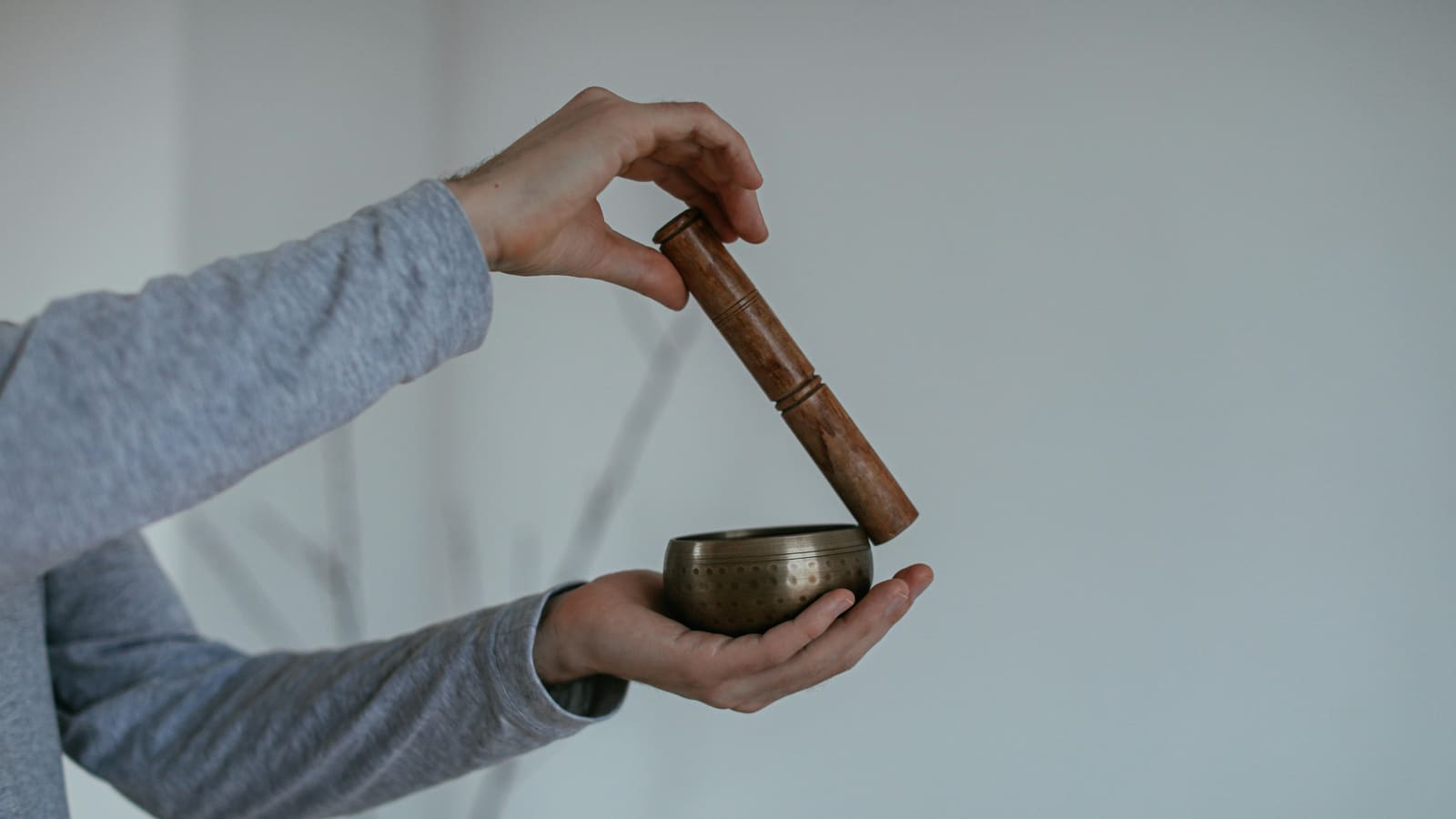
The acoustic property that defines a Tibetan bowl is multi-tonal overtones. A struck Tibetan bowl produces a fundamental pitch plus a constellation of upper harmonics, often described as a “shimmer” or “halo” around the main note. Played around the rim with a leather-wrapped wood mallet, the bowls produce a layered drone that two listeners can describe in very different terms — one hearing a low warm tone, another hearing a high, almost bell-like ringing.
Tibetan bowls range widely. A small antique bowl with a clear fundamental can be USD 100–250. A large hand-forged bowl with strong overtone profile is USD 300–800. Genuinely antique bowls (over a century old) command premium prices and are increasingly hard to verify in a tourist market that produces excellent contemporary work alongside misrepresented new-bowls-aged-on-purpose.
The “seven metals” claim that pervades Tibetan bowl marketing — that each bowl was forged from seven metals, each tied to a planet — is mostly symbolic-tradition, occasionally true, rarely verifiable. Analyses of antique bowls in museums show that the metallurgy was variable: primarily copper-tin bronze with intermittent traces of iron, silver, gold, lead and zinc. Modern bowls sold as “seven-metal” usually contain mostly copper, tin and possibly a small amount of silver. If the maker offers a metallurgical analysis on request, you have a serious instrument. If they only offer the planetary story, take it as folklore.
Which to choose
If you are buying for personal practice at home, a single mid-size Tibetan bowl is hard to beat — versatile, layered, atmospheric, less than the cost of a comparable crystal bowl. The overtones reward longer practice; they unfold the more you sit with them.
If you are building a facilitator’s set for group sessions, you almost certainly want both. A few frosted crystal bowls in different pitches provide the sustained-tone backbone of a session. A handful of Tibetan bowls add overtone texture and layering. Most working facilitators in Mexico City studios run hybrid sets for this reason.
If you are attending a session (not buying), the differences matter less than the marketing suggests. The peer-reviewed literature on sound baths (Stanhope & Weinstein, 2020; Bidin et al., 2016) reports similar tension and anxiety reductions across both bowl families. What matters more for the listener’s experience is the room acoustics, the facilitator’s pacing, and the container’s safety — not whether the bowls are crystal or metal.
Where to buy in Mexico
A specific note for the directory’s audience.
- Mexico City has two reliable importer-shops for crystal bowls (Sundari and others in Roma Norte); Tibetan bowls in CDMX are easier to find at Tianguis del Chopo on weekends, in incense shops in Condesa, or imported by individual facilitators.
- Tulum has retail availability but at substantial markup; most tourists will overpay.
- Direct from Nepal is genuinely worth considering for Tibetan bowls — the shops in Patan ship internationally and the saving is significant. Allow 4–6 weeks for delivery into Mexico.
- From the United States (Crystal Tones, et al.) for alchemy bowls — expect import duties.
What to try this week
If you are considering a first bowl, go to a sound bath in your city and stay after to ask the facilitator if you can touch their instruments. Most are happy to show you. Strike one yourself. Run the mallet around the rim. You will know within thirty seconds which type your body prefers — pure-tone or layered-overtone. That preference is the most useful purchasing data you will get.
If you cannot get to a session: listen, attentively, to recordings of both. A single 10-minute frosted-bowl recording followed by a single 10-minute Tibetan-bowl recording, on speakers (not headphones), at a volume where you can feel the low end. Notice which one your shoulders drop into more. That bowl is, for you, the right place to start.
FAQ
Quick answers
Are 'seven-metal' Tibetan bowls actually seven metals?
Which is better for a beginner?
What about clear-quartz 'alchemy' bowls?
Sources
What this is built on
- Stanhope, J., & Weinstein, P. (2020). The human health effects of singing bowls: A systematic review. Complementary Therapies in Medicine, 51. doi.org
- Crystal Tones (US) and Sound Galaxy (NL) — manufacturer specifications and tuning documentation. Industry primary sources on quartz purity and tuning methodology.
- Hood, Sonu (Patan, Nepal) — interview with Himalayan bowl maker, December 2025. Conversation on alloy composition and the 'seven-metals' tradition vs reality.
- Bidin, L., et al. (2016). Tibetan singing bowls feasibility trial. Palliative and Supportive Care, 14(4), 415–419. doi.org
Spot something off — a date, a citation, a lineage detail? Write to [email protected] and we will fix it.
Keep reading
What are the 5 healing sounds? — the Taoist practice behind the phrase
The 'healing sounds' people search for are the Taoist Liu Zi Jue — and there are properly six, mapped to five organ systems. Here is where they come from, what each one is, and what they actually do.
Overtone singing — what it is, where it comes from, and what it does to attention
One voice, two notes at once. The technique is older than written history and easier to learn than it looks. Here is the physiology, the lineages it belongs to, and why a single overtone changes the room.
What a sound bath actually is — and what 'just music with bowls' misses
A sound bath is a specific format, not a vibe. Lying down, dim room, no phones, a facilitator who runs the time. The thing that does the work is not the bowls — it is what the bowls make easy.
Do healing sounds actually work? — an honest read of the evidence
Yes, for what they plausibly claim: lower tension, anxiety and arousal, mostly short-term, through mechanisms we can name. No, for curing disease or repairing DNA. Here is where the line actually sits.