Lineage, place and respect
The Aztec death whistle — the sound, the find, and the modern myth
What the whistle actually sounds like, what we know about where it was found, and why the 'thousand-souls scream' YouTube clips are doing the instrument a disservice.
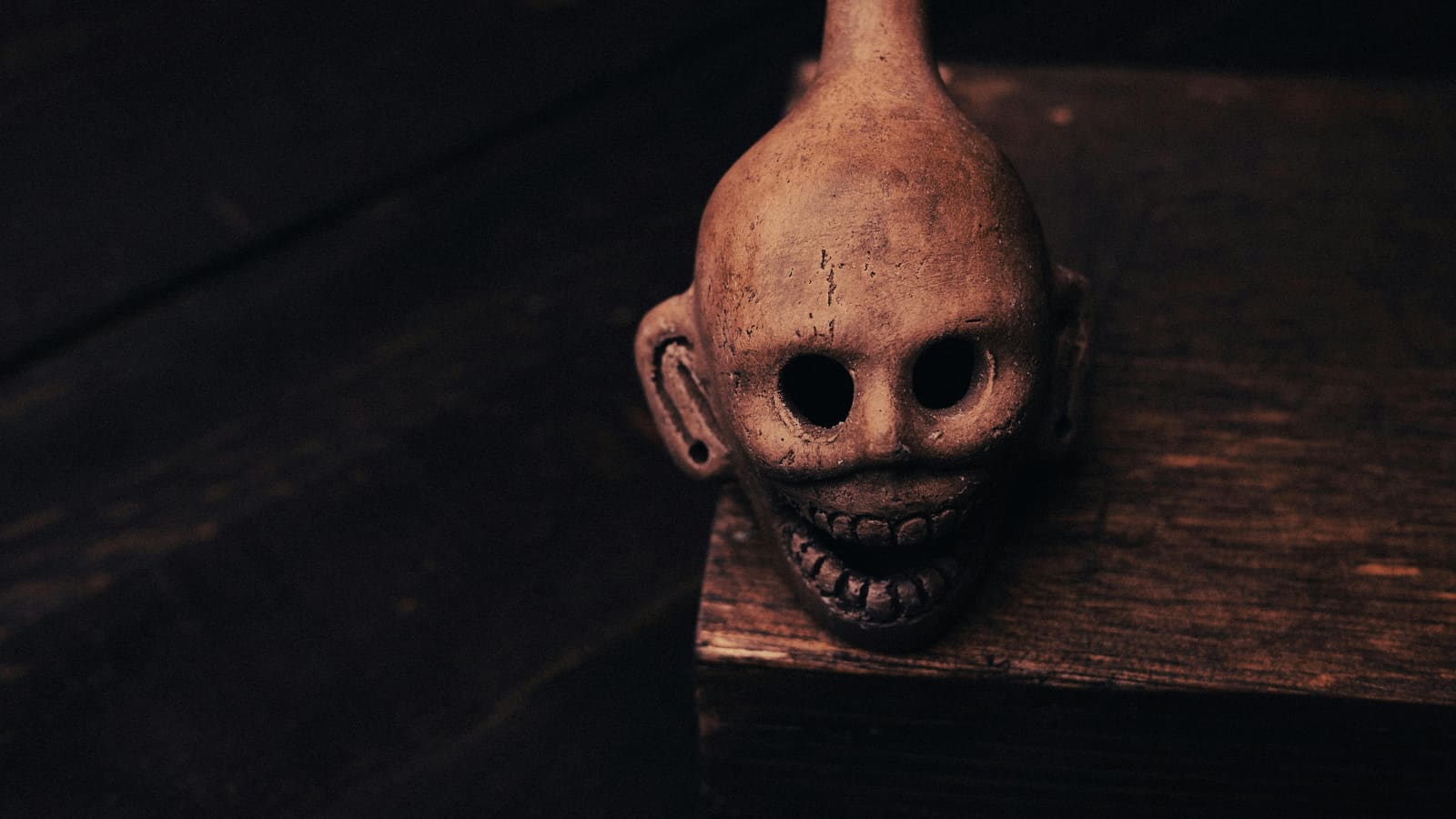
A small piece of clay, shaped like a human skull, perhaps four centimetres across. A modest object you could palm without effort. Found, in the most famous case, clutched in the bony hand of a sacrificed teenage skeleton at Tlatelolco, the great market and ceremonial centre of the Mexica capital. The archaeologists who pulled it out of the dirt in the 1990s did not know what it was. When someone finally blew into it, the room — by all accounts — went quiet.
It made a sound that did not seem to come from a small clay whistle.
What it actually sounds like
The instrument has been spectacularly mischaracterised by viral video. The clips that circulate as “the terrifying sound of the Aztec death whistle” are almost universally blown by enthusiasts at maximum pressure, recorded close, sometimes pitched down or echoed in post. The result is the screaming-souls clip that the internet finds delicious.
Played gently — the way a small clay whistle is most naturally played — the death whistle produces a sound closer to a strong wind funnelling through a narrow doorframe. There is breath in it. There is turbulence in it. There are vocal-sounding overtones that an attentive ear will recognise as something between a moan and a hoarse exhale. It is unsettling, but not in the cinematic-horror way the clips suggest. It is unsettling in the way a recording of someone’s last words might be unsettling.
The engineer Roberto Velázquez Cabrera, working out of his independent research project on pre-Hispanic Mexican wind instruments, spent twenty years analysing how these whistles worked and recreating them in the same materials. His verdict, as he expressed it in multiple papers and interviews: the instrument was an acoustic spring, a deliberate mechanism that produced not a musical note but a complex, vocal-sounding turbulence. He believed the design was sophisticated and intentional, not accidental. He also, repeatedly, asked the public to stop blowing them violently for YouTube clips — that, he insisted, was not the instrument’s voice.
The archaeology — what we know, and what we don’t
The Tlatelolco find is the most famous, but it is not the only one. Similar whistles have been recovered from multiple Mexica and earlier Mesoamerican burial contexts, generally dated to the late post-classic period (roughly 1300–1521 CE), with antecedents in earlier Maya material that suggest the air-spring whistle form was invented by the Maya around 700–800 CE and adopted into the broader Mesoamerican instrument tradition over the following centuries.
What is established by direct archaeological evidence:
- The whistles appear in burials, often clutched in the hand of the deceased or placed near the head.
- They appear at sites of sacrificial deposition, including Tlatelolco’s mass grave context.
- They are skull-shaped or skull-decorated in a substantial subset of finds, linking them iconographically to Mictlán (the Mexica underworld) and to Mictlantecuhtli, lord of the dead.
- They were made deliberately, not accidentally — the air-spring mechanism is not a simple flute. The makers knew what they were doing.
What is not established by archaeology:
- That they were used in battle. There is no surviving battlefield deposit of multiple death whistles. The “psychological warfare” theory comes from late 20th-century speculation, not from primary sources.
- That hundreds were blown at once. There is no Mexica chronicle (Sahagún, Durán, the codices) that describes mass whistle use in war or ceremony.
- That the sound was used to “terrify enemies” rather than, for example, to accompany the soul on its journey.
The honest interpretive line, the one Velázquez Cabrera himself took, is: the whistles were funerary instruments, almost certainly tied to the cosmology of death and the underworld journey. Whether they had additional ceremonial uses — for healing, divination, communication with the dead — is plausible but unproven.
Why the modern myth is so persistent
The “death whistle as psychological warfare device” story is everywhere because it is good content. It combines pre-Columbian exoticism, a viscerally disturbing sound, and a cinematic image (massed warriors, terrified opponents) into a tweetable narrative. Documentary segments lean on it. Game soundtracks borrow from it. The Mexican tourism economy, in a small way, sells it.
This narrative is not exactly false — it just isn’t archaeologically supported and probably misrepresents the original function. The whistles were grave goods. They accompanied the dead. Their voice was for the underworld. That story is, if anything, more interesting than the war-trumpet version.
The way the misinformation cycle plays out is also worth noting. A clip goes viral. A YouTube voiceover paraphrases the war theory. A documentary cites the YouTube voiceover. An article cites the documentary. By the time the citation reaches Wikipedia, the original source — speculation from the 1990s — has been laundered into “consensus”. Velázquez Cabrera, before his death in 2024, spent years pushing back against this. He was, broadly, ignored by the algorithm.
Hearing one in real life
You can hear original whistles in two places, both in Mexico City:
- Museo Nacional de Antropología, Mexica Hall. The collection includes several whistles, displayed in glass cases. They are not played; you see them and read the label.
- Museo del Templo Mayor, also in central Mexico City, has excavated examples from the Templo Mayor site, including whistles in funerary context.
To hear one, the best contemporary recordings are the ones made by Velázquez Cabrera’s project, available online through his archive. Recordings of original museum instruments (not replicas) are vanishingly rare. Replicas, played by trained players who understand the air-spring mechanism rather than YouTubers exploiting it, are more honest representations than the viral content.
Replica whistles are also sold at the Museo de Arte Popular shop, at the Templo Mayor museum gift shop, and from individual artisans in Puebla. Expect MXN 150–500 for a well-made replica. They are not healing instruments. They are not toys, either. Most people who buy one play it once and put it on a shelf.
What to try this week
If you are in Mexico City, go to the Mexica Hall at the Museo Nacional de Antropología. Find the case with the small wind instruments — flutes, whistles, ocarinas. Read the label. Stand for ten minutes. Notice the size of the objects. Notice the skull iconography. You are looking at the surviving voice-objects of a civilisation that took the sound of death seriously enough to bury small, sophisticated noise-makers with its dead.
That is the instrument. The viral clips are a misrepresentation. The instrument deserves a slower look.
If you are not in Mexico, the closest thing to honest engagement is to find Velázquez Cabrera’s recorded examples on his archive (tlapitzalli.com) and listen at low volume, in the dark, once, without commentary. It will not entertain. It will, possibly, make you understand why these were buried where they were buried.
FAQ
Quick answers
Did the Aztecs use death whistles in battle?
Where can I see or buy one?
Why does it sound so disturbing?
Sources
What this is built on
- Velázquez Cabrera, R. (multiple papers). Estudios mexicanos de música prehispánica. tlapitzalli.com
- Both, A. A. (2007). Aztec Music Culture. The World of Music, 49(2), 91–104. Survey of Mexica musical instruments in ceremonial context.
- Sahagún, B. de (16th century). General History of the Things of New Spain (Florentine Codex). Translated by Anderson & Dibble. Primary colonial chronicler. Detailed accounts of Mexica music and ceremony, though filtered through Christian missionary perspective.
- Instituto Nacional de Antropología e Historia (INAH), Mexico — Tlatelolco archaeological collection. inah.gob.mx
Spot something off — a date, a citation, a lineage detail? Write to [email protected] and we will fix it.
Keep reading
What does God say about sound healing?
Scripture never mentions 'sound healing' the wellness modality — but nearly every religious tradition treats sound, song and chant as a way to the sacred and a balm for the troubled. Here is what the texts actually say, and where the tension is.
Cacao ceremony — what is Mesoamerican lineage and what is 2020s invention
Cacao has a 3,500-year history of ritual use in Mesoamerica. The modern *ceremony of cacao* that you can attend at a yoga studio in Tulum is largely a 1990s reconstruction. Both are real. They are not the same thing.
Temazcal in 2026 — what it is, who can lead it, and what gets sold under its name
A temazcal is not a sauna. It is a Mesoamerican ceremony that survived five centuries of colonisation and is now, in many wellness retreats, being smoothed into something it never was. Here is the form, the lineage, and the honest distinctions.
Do healing sounds actually work? — an honest read of the evidence
Yes, for what they plausibly claim: lower tension, anxiety and arousal, mostly short-term, through mechanisms we can name. No, for curing disease or repairing DNA. Here is where the line actually sits.