Lineage, place and respect
Pre-Columbian Mexico had a vast sound-instrument tradition — and most of it is still being decoded
Thousands of clay ocarinas, conch trumpets, slit drums and the so-called death whistles have come out of Mexican soil. What they sounded like, what they were for, and what we still do not know.
When archaeologists open a Mexica burial, they often find a whistle. Sometimes a clay flute. Sometimes an ocarina shaped like a deer or a frog. Sometimes a thing the modern world now calls a silbato de la muerte — death whistle — that, when blown, produces a sound somewhere between wind and a strangled human cry. They were buried with the dead, deliberately, for reasons we are still piecing together.
The popular accounting of pre-Columbian music in Mexico is thin. There is the huehuetl, a tall skin drum. There is the teponaztli, a slit log drum. There are conch shells. That is roughly where most foreign visitors leave it. The actual archaeology is wider, stranger and considerably less mystified than the wellness internet would have you believe.
What has actually been found
Thousands of clay aerophones — whistles, flutes, ocarinas, trumpets — have been excavated from Olmec, Mayan, Mixtec, Zapotec, Toltec, Aztec and post-classic Mexica sites (Both, 2007). Many are shaped like animals: parrots, dogs, deer, monkeys, frogs. Some are anatomical, shaped like human faces or skulls. They are not novelty objects: the same shapes recur at sites separated by hundreds of miles and several centuries.
A few specific finds are worth naming, because the headlines almost never do.
- Triple- and quadruple-chamber flutes from the Maya site of Jaina, an island cemetery off the Campeche coast. A single breath through one of these produces multiple sustained tones at once. Some of them are tuned in intervals that produce slow acoustic beating — the same physical phenomenon underneath binaural beats, except a thousand years earlier and without headphones.
- The atecocoli, the conch trumpet of the Mexica. Sahagún’s chroniclers recorded it being sounded at the start of ceremonies and at hours of the day. The instrument survives unbroken: it is still blown at temazcal openings in Mexico City today.
- The huehuetl (skin drum) and teponaztli (slit log drum), recorded in the Florentine and Borbonicus codices as the two backbone instruments of Mexica music. Surviving examples sit in INAH collections in Mexico City. The teponaztli’s two tongues produce a distinct two-pitch interval, often a major third.
- The omichicahuaztli, a notched bone rasp, sometimes carved from a human femur. Pre-Hispanic and contemporary Maya use suggests it was for funerary and divinatory contexts.
- The so-called silbato de la muerte (death whistle). The most famous was excavated at Tlatelolco, clutched in the hand of a sacrificed skeleton. The engineer Roberto Velázquez Cabrera spent decades reconstructing how these worked — an “air spring” chamber, a Maya invention around 700–800 CE, capable of producing the rough, wind-like roar that has now (somewhat to his frustration) become a viral curiosity.
What the instruments were for — what is known, what isn’t
Honest answer first: we know a lot less than the YouTube voiceovers suggest.
What is well-supported by codex evidence and Spanish chronicler accounts (Sahagún, Durán) is that instruments structured ceremony. The huehuetl and teponaztli marked time. The atecocoli opened and closed ritual moments. Flutes accompanied processions and possibly funerary rites. Singers — the cuicapicqueh, song-poets — performed at major calendrical observances. There is no real doubt that sound was integral to Mexica religion.
What is less well-supported but plausible is that certain instruments accompanied healing. The frog-shaped ocarinas may have been used by herbalist-healers; some sources connect them to rain-bringing and crop ceremony rather than what we’d now call clinical practice. The bone rasps and skull whistles are associated with the cult of Mictlan, the underworld, and funerary procession — passage of the dead, not healing of the living.
What is not well-supported is the claim — popular in modern sound-healing circles — that pre-Columbian peoples possessed “advanced frequency healing technology” that we have lost. The instruments are sophisticated. The acoustic phenomena they produce (beating, multi-tone, low-frequency rumble) are real. But the leap from “they had whistles” to “they understood DNA frequencies” is a marketing leap, not an archaeological one.
The most measured contemporary specialist on these instruments was Velázquez Cabrera himself, who worked from the engineering rather than the romance. His position was that the instruments demonstrate considerable acoustic ingenuity and that their exact ritual semantics are mostly lost. That is the honest line.
The death whistle, calmly
It deserves its own paragraph because it has acquired a viral life that has nothing to do with its archaeology.
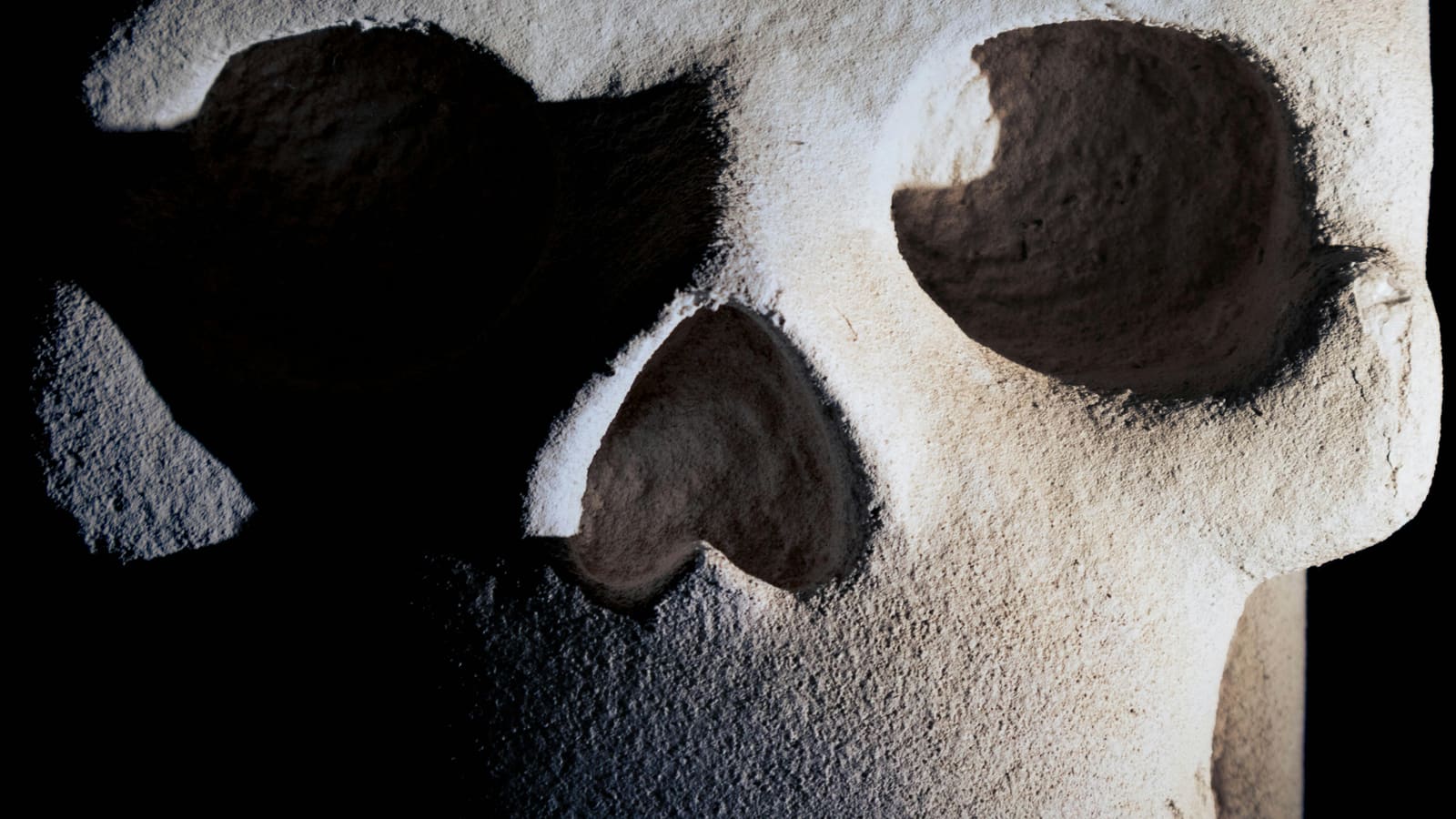
The Tlatelolco whistle is small — fits in a fist — and shaped like a skull with an air chamber that produces a turbulent, almost vocal-sounding sound when blown. The famous “scream of a thousand tortured souls” clips on TikTok are real, but they are blown harder, recorded close, and often pitched-down in post. Blown gently, the same whistle makes a sound closer to a strong wind through a doorframe.
The two surviving interpretive theories, both speculative:
- Psychopomp. The whistle accompanied the soul on its journey to Mictlán, the underworld. The recording-of-death theory. Funerary context fits this best.
- Battlefield terror. Hundreds of these whistles sounded together, allegedly, before Mexica forces engaged. There is no surviving battlefield archaeology of multiple such whistles found together. The theory comes from later 20th-century speculation.
You can buy a replica from artisans in Mexico City and Puebla today. Treat it as a curio, not a healing tool. The whistle’s archaeological context is funerary; it was not blown into anyone’s ear for relaxation, ever.
Where this lives in modern Mexico
The unbroken line is the danza azteca tradition — communities, mostly in Mexico City and across the central highlands, who continue to drum huehuetl and teponaztli in calendar ceremony. The unbroken line for the atecocoli runs through the temazcaleros who open and close their sweat lodges with the conch. In Wirikuta, in San Cristóbal de las Casas, in the Sierra Norte de Puebla, related song and drum traditions survive in Indigenous communities who keep them quietly and rarely sell them.
You can also see the original instruments. The Mexica Hall at the Museo Nacional de Antropología in Mexico City holds a particularly good collection. The Maya hall has the Jaina figurines and their flutes. The Mexico City Templo Mayor museum displays excavations including drums and rattles. These are not “energy artefacts” but they are, in the most literal sense, the surviving sound-objects of the people who lived here before.
What to try this week
If you are in or near Mexico City, this is one of the simplest weekend rituals available to someone interested in sound:
- Go to the Mexica Hall at the Museo Nacional de Antropología on a weekday morning. Sit with the instrument case for ten minutes. Read what is known about each piece.
- Find a danza azteca circle in the Zócalo — they gather most weekends — and stand for a while at a respectful distance and listen. The drums in person are nothing like the drums on a recording.
- If you can find a temazcal led by a Mexica-tradition temazcalero, attend one. The opening conch is the same instrument the codex describes, blown the same way it has been blown for five hundred years and probably longer.
That is a closer encounter with pre-Columbian sound than any fusion sound journey in a hotel basement will give you. It is also free.
FAQ
Quick answers
Was the Aztec death whistle actually used to terrify enemies?
Did pre-Columbian Mexicans practice 'sound healing' in the modern sense?
Can I hear these instruments today?
Sources
What this is built on
- Both, A. A. (2007). Aztec Music Culture. The World of Music, 49(2), 91–104. Foundational survey of Mexica instruments and their ceremonial contexts.
- Stevenson, R. (1968). Music in Aztec & Inca Territory. University of California Press. Long-standing reference work on huehuetl, teponaztli and other pre-Hispanic instruments.
- Velázquez Cabrera, R. (2017). Mecanismos de los silbatos prehispánicos. Estudios mexicanos de música prehispánica. tlapitzalli.com
- INAH — Instituto Nacional de Antropología e Historia: Museo Nacional de Antropología, Mexica Hall. inah.gob.mx
- Anders, F., Jansen, M., & Reyes García, L. (1991). El libro del Cihuacoatl: Códice Borbónico. Fondo de Cultura Económica. Codex showing musicians and instruments in calendrical ceremony.
Spot something off — a date, a citation, a lineage detail? Write to [email protected] and we will fix it.
Keep reading
What does God say about sound healing?
Scripture never mentions 'sound healing' the wellness modality — but nearly every religious tradition treats sound, song and chant as a way to the sacred and a balm for the troubled. Here is what the texts actually say, and where the tension is.
Cacao ceremony — what is Mesoamerican lineage and what is 2020s invention
Cacao has a 3,500-year history of ritual use in Mesoamerica. The modern *ceremony of cacao* that you can attend at a yoga studio in Tulum is largely a 1990s reconstruction. Both are real. They are not the same thing.
Temazcal in 2026 — what it is, who can lead it, and what gets sold under its name
A temazcal is not a sauna. It is a Mesoamerican ceremony that survived five centuries of colonisation and is now, in many wellness retreats, being smoothed into something it never was. Here is the form, the lineage, and the honest distinctions.
Do healing sounds actually work? — an honest read of the evidence
Yes, for what they plausibly claim: lower tension, anxiety and arousal, mostly short-term, through mechanisms we can name. No, for curing disease or repairing DNA. Here is where the line actually sits.